
THANK YOU FOR SUBSCRIBING
× 
Prop Tech Outlook Weekly Brief
Be first to read the latest tech news, Industry Leader's Insights, and CIO interviews of medium and large enterprises exclusively from Prop Tech Outlook


 Dan Dietzen, Lead Systems Designer
Years ago, a Florida condominium owned by one of the company’s founders suffered a severe water leak when a hose connected to a toilet supply line failed in the middle of the night. Because the founder had combined two units, the incident flooded both spaces and ultimately affected 14 units across seven floors. The experience became even more significant because he had been elected president of the condominium board just two weeks earlier.
The board initially focused on prevention by replacing toilet supply lines throughout the property with braided lines. But leaks continued, involving backed-up drains, appliances such as dishwashers, and HVAC equipment. The experience showed that preventive maintenance alone was not enough. The property needed a system capable of actively defending against leaks.
Halo began by trying existing leak detection technology but found conventional systems poorly suited to complex condominium environments, where ownership changes, occupancy varies and on-site staffing is limited. So Halo developed its own building-wide system that provides visibility to property managers, maintenance teams and individual owners, backed by a 24/7 call centre that owners and staff can reach directly and a network of Halo service technicians.
“Detecting a leak on day one is the easy part. Supporting that system year after year is where most fall short. That’s where every decision we make and all of our R&D go, and it’s where Halo shines,” says Dan Dietzen, Lead Systems Designer at Halo Protection Systems.
That focus on long-term support is why Halo designs its own sensors. The company found that the sensors available on the market were not built to hold up for years inside occupied homes. Halo sensors are self-adhering, so they stay where they are placed through cleaning, repairs and everyday life, and their sensing technology is designed to resist the dust, dirt and moisture that wear sensors down over time. Each sensor carries a 10-year battery life, and Halo commits to keeping parts available for 10 years, so a building is not forced to switch systems or mix hardware.
Fast Response Through Intelligent Automation
Unlike systems that only detect leaks, Halo helps communities act on them quickly. It can automatically shut off the water to the individual unit where a leak is detected, while the rest of the building keeps its water. Its wireless technology allows sensors to communicate directly with the system, enabling rapid action without relying on a resident’s internet connection or cellular service.
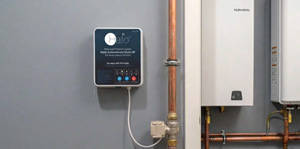 Battery-powered valves also provide flexibility in locations where electrical access may be limited. Optional flow meters track each unit’s water use and can close the shutoff valve on their own.
Halo is also built for what happens after a leak. Sensors can stay mounted while an area dries out, so they are not pulled up during cleanup and then put back in the wrong spot, or forgotten entirely. That means less work for residents and property teams and less disruption during an incident.
Reliable Coverage and Valuable Insights
Residential buildings present unique challenges, including concrete structures, multiple layouts and difficult conditions. Halo uses long-range wireless technology designed to penetrate walls and concrete while providing flexible coverage throughout a property. This eliminates many of the reliability issues associated with traditional systems.
Beyond preventing damage, Halo provides detailed information about where issues occur. By identifying the specific unit, room and sensor involved, maintenance teams can respond quickly. Historical data also helps properties recognise patterns, identify recurring problems and plan preventive maintenance before issues become costly repairs.
Creating Long-Term Value for Communities
Halo’s value shows up most in the moments that tend to fall through the cracks, like a change in ownership.
In one condominium, a unit had just been sold. The new owner had not even visited yet, and the utilities were not yet in the owner’s name. Then a leak started near the water heater. Halo did not depend on the new owner moving in or setting up a single account. The system belongs to the association and kept working straight through the sale, so property staff got the alert and responded before significant damage occurred.
Halo can also uncover water waste no one can see. At one property, a construction defect left a unit’s water supply running nonstop into a drain, hidden from view. Halo tracked the constant flow, which added up to more than 1.2 million gallons a year from that single unit, so the association could find the problem and stop paying for water no one was using.
Recognised for Innovation and Growth
As Halo Protection Systems continues expanding nationwide, the company remains focused on combining technology, service and problem-solving for residential communities. Its goal is to deliver protection that works not only on installation day but throughout the life of a property.
Halo Protection Systems has been named Top Smart Water Leak Detection System 2026, recognising its commitment to developing reliable and intelligent solutions that help condominium and multifamily properties prevent damage, improve maintenance and gain greater control over their water systems.
By combining wireless technology, automated shutoff capabilities and long-term service support, Halo aims to help residential communities respond to leaks more effectively, reduce water waste and protect their properties over the long term.
When Smart Leak Detection Must Act Automatically
Water damage in multifamily properties rarely follows a convenient response window. A slow appliance leak may sit unnoticed behind a wall, while a supply-line failure can send water into several residences before maintenance reaches the source. Smart leak detection therefore has to do more than generate an alert. The useful distinction is whether the system can identify where water is appearing and act before staff arrive. It also has to remain dependable across units that differ in layout, occupancy, ownership and access.
Response control deserves close scrutiny because notification alone still leaves a gap between detection and intervention. A system that can isolate water at the affected unit reduces dependence on an owner answering a phone or a technician reaching the valve. Buyers should examine how quickly sensors communicate with shutoff controls and whether multiple supply lines can be handled within one residence. Power design matters here. Valves installed near plumbing may not have convenient electrical service, while breakers can be switched off in vacant or seasonal units. The control path should remain available under those ordinary building conditions.
Network design becomes equally important once hundreds or thousands of devices are spread through concrete construction. Resident Wi-Fi introduces password changes and uneven participation, while cellular coverage can vary by floor or mechanical space. A dedicated long-range network can remove those dependencies, but buyers still need to understand how coverage is established and how device health is monitored. Installation should also accommodate older buildings without forcing extensive rewiring or surrendering outlets residents already use.
Precision at the sensor level changes how maintenance teams treat an alert. A notice that names only an apartment can still require a lengthy search through several rooms. Locationspecific information narrows that work to the exact room and sensor position, making small leaks easier to verify before they are deferred. Sensor placement also warrants attention. Devices should remain fixed where water is likely to appear while staying clear of routine cleaning or repair activity. Their ability to tolerate moisture exposure and common household chemicals affects whether early accuracy survives years of use.
“Halo maps alerts to the unit and sensor location, while its dedicated long-range network reduces reliance on resident Wi-Fi or inconsistent cellular service.”
Long-term service is the quieter procurement issue. Units are sold, renovated, rented or left vacant, which can shift sensors or change plumbing conditions. A system installed correctly on day one can drift from its intended coverage if no one checks sensor placement and device status. Property teams should ask who maintains the network and who supports occupants outside staffed hours. Historical incident or water-use data can also reveal recurring patterns that deserve maintenance attention.
Halo Protection Systems combines building-wide wireless detection with battery-operated automatic shutoff controls designed for condominium environments. Halo maps alerts to the unit and sensor location, while its dedicated long-range network reduces reliance on resident Wi-Fi or inconsistent cellular service. It also pairs installation with ongoing technician support and 24/7 assistance for owners or occupants who need help after an event. That service model addresses the harder part of leak protection, keeping device placement and system response dependable as units change over time. For condominium operators prioritizing automatic intervention, precise location data, dedicated connectivity and sustained upkeep, Halo merits close consideration.
...Read more
Company
Halo Protection Systems
Management
Dan Dietzen, Lead Systems Designer
Description
Halo Protection Systems delivers intelligent smart water leak detection solutions designed for condominium and multifamily properties. Combining advanced wireless technology, automated shutoff capabilities and long-term service support, Halo helps communities prevent costly water damage and improve maintenance through real-time insights.
